

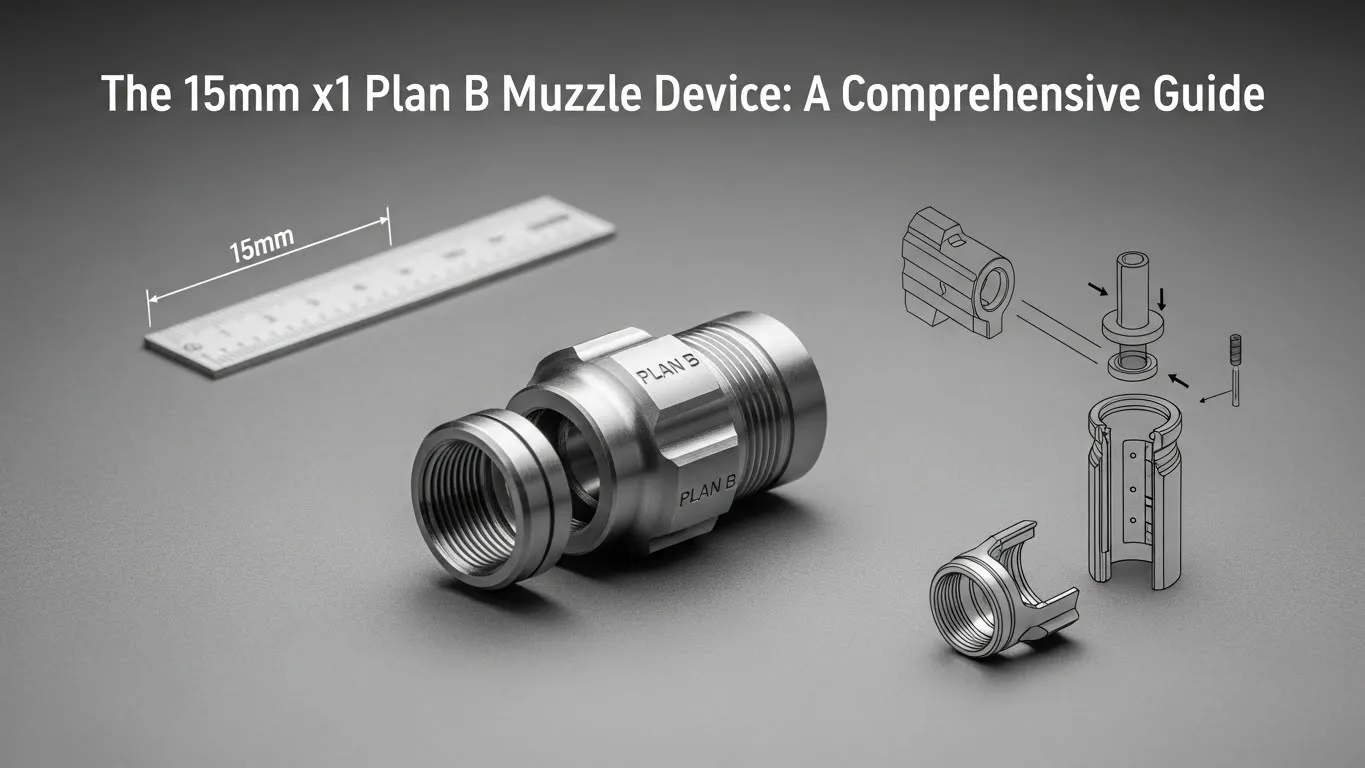
To appreciate the 15mm x1 Plan B Muzzle Device, one must look at the two distinct standards it unites. The “15mm x1” designation refers to a metric thread pitch (15 millimeters in diameter with a 1mm thread lead), which is the factory standard for several high-end European platforms, including certain Accuracy International, HK, and Sauer rifles.
The “Plan B” portion of the name refers to the mounting geometry popularized by Q LLC. It is a taper-mount system that eliminates the need for ratchets, springs, or secondary locking collars. When you install a 15mm x1 Plan B Muzzle Device on your rifle, you are effectively upgrading your barrel to accept any suppressor equipped with a Plan B-style adapter, creating a streamlined and gas-tight interface.
Technical Advantages of the Plan B Ecosystem
Choosing a over a standard quick-detach (QD) mount offers several mechanical benefits that directly translate to better performance on the range or in the field.
1. The Power of the Taper
The primary benefit of the is its 25-degree taper. As the suppressor is threaded onto the device, the internal taper of the silencer meets the external taper of the muzzle device before the threads fully bottom out. This creates a massive amount of surface area contact, which:
-
Ensures Concentricity: It aligns the suppressor perfectly with the bore.
-
Prevents Carbon Locking: By creating a gas-tight seal, it prevents carbon buildup from reaching the threads, making the suppressor easier to remove after a long day of shooting.
2. Significant Weight Savings
Traditional mounting systems are often heavy, adding bulk to the most sensitive part of the rifle—the muzzle. Because the is a solid piece of machined steel with no moving parts, it is significantly lighter than “ratcheting” alternatives. This reduces the “pendulum effect” on the barrel, helping to preserve the rifle’s natural balance.
3. Minimal Point of Impact (POI) Shift
Every time you add a weight to the end of a barrel, the harmonics change. However, the is designed to be so consistent in its lockup that the POI shift is predictable and repeatable. For long-range shooters, this means they can confidently remove their suppressor for transport and reattach it without needing to re-zero their optic.
Installation Procedures for the 15mm x1 Plan B Muzzle Device
Proper installation is the difference between a successful range day and a damaged suppressor. Because the serves as the mounting shoulder for your silencer, it must be installed with precision.
Preparation and Alignment
Before beginning, ensure your barrel threads are clean and free of burrs. When dealing with a metric thread like the 15mm x1, it is vital to check if your barrel has a shoulder for the device to index against. Most models are designed to index off the muzzle face or a 90-degree shoulder.
Torque and Securing
-
Degrease: Clean both the barrel threads and the internal threads of the muzzle device with a solvent like acetone.
-
Thread Locker: Apply a drop of Rocksett to the threads. Rocksett is highly recommended for the because it is heat-resistant up to 2,000°F but can be broken loose with a shock or a water soak if removal is necessary.
-
Torque: Use a torque wrench to tighten the device to approximately 25–30 ft-lbs. Do not over-torque, as this can cause bore constriction in some thin-profile barrels.
Material Science: Why 17-4 Stainless Steel Matters
When purchasing a 15mm x1 Plan B Muzzle Device, you will notice most are made from 17-4 PH Stainless Steel. This is not an arbitrary choice.
The muzzle device acts as a “sacrificial” component. As hot, abrasive gases exit the barrel, they strike the muzzle device first. 17-4 Stainless Steel is chosen for the 15mm x1 Plan B Muzzle Device because it can be heat-treated to a high hardness, allowing it to withstand thousands of rounds of “sandblasting” from unburnt powder without eroding. This ensures the mounting taper remains perfectly smooth for the life of the rifle.
Comparing 15mm x1 Plan B Muzzle Device to Traditional QD
| Feature | Plan B (Taper) | Traditional QD (Ratchet) |
| Lockup Type | Friction/Taper | Mechanical/Click |
| Length Added | Minimal (approx. 1″) | Significant (2″+) |
| Durability | High (No moving parts) | Moderate (Springs can fail) |
| Weight | 1.5 – 2.5 oz | 4.0 – 6.0 oz |
The 15mm x1 Plan B Muzzle Device is clearly the winner for those seeking a “low profile” setup. While traditional QD systems are faster for “on-and-off” transitions in tactical environments, the Plan B system is superior for accuracy and long-term reliability.
Maintenance and Care for Your Muzzle Device
Maintaining your 15mm x1 Plan B Muzzle Device is straightforward but essential. Because the seal depends on the integrity of the taper, you should periodically inspect the device for any dings or carbon buildup.
-
Carbon Removal: Use a nylon brush and a carbon-cutting solvent to keep the taper surface smooth. Avoid using metal scrapers that could scratch the precision-machined surface.
-
Thread Inspection: Occasionally check that the 15mm x1 Plan B Muzzle Device remains torqued to the barrel, especially after heavy strings of fire that involve significant heat cycles.
Conclusion: The Future of Muzzle Interfacing
The 15mm x1 Plan B Muzzle Device is more than just a piece of steel; it is a specialized tool that brings modern suppressor technology to classic and precision European rifle platforms. By prioritizing the physics of the taper mount over the convenience of a “quick-click” button, it offers a level of stability and accuracy that was previously difficult to achieve.
Whether you are looking to shave weight off your hunting rig or ensure your precision rifle maintains its sub-MOA capabilities while suppressed, the 15mm x1 Plan B Muzzle Device is an investment in the long-term performance of your firearm.
Frequently Asked Questions
1. Can I use a 15mm x1 Plan B Muzzle Device on a .30 caliber rifle?
Yes, as long as the internal bore of the muzzle device is large enough for the projectile. Most 15mm x1 Plan B Muzzle Device options are bored for .30 caliber (7.62mm) or smaller, but you must always verify the manufacturer’s specifications before firing.
2. Why is my suppressor stuck to the Plan B device?
This is usually caused by “carbon lock” or overtightening while the metal was hot. To remove it, allow the rifle to cool completely. Usually, a firm “snap” of the wrist will break the taper seal. Using a small amount of high-temp anti-seize on the threads (not the taper) can help prevent this.
3. Does the 15mm x1 Plan B Muzzle Device require shims?
Most Plan B devices are “non-timed,” meaning they don’t have a “top” or “bottom” and do not require shims. However, if your 15mm x1 Plan B Muzzle Device is a specific style of muzzle brake with lateral ports, you will need a 15mm shim kit to align the ports horizontally.
4. Is the Plan B system compatible with Rearden or Liberty Precision?
Yes! One of the best things about the 15mm x1 Plan B Muzzle Device is that it is part of an open-source geometry. Companies like Rearden Mfg and Liberty Precision make parts that are 100% compatible with the Plan B taper standard.
5. Will this device fit an HK MR308 or HK91?
Many HK rifles use a 15mm x1 thread pitch. However, some HK models have a unique “spline” or shoulder. You should verify that your specific HK barrel has enough thread depth to fully seat the 15mm x1 Plan B Muzzle Device against the shoulder.
