

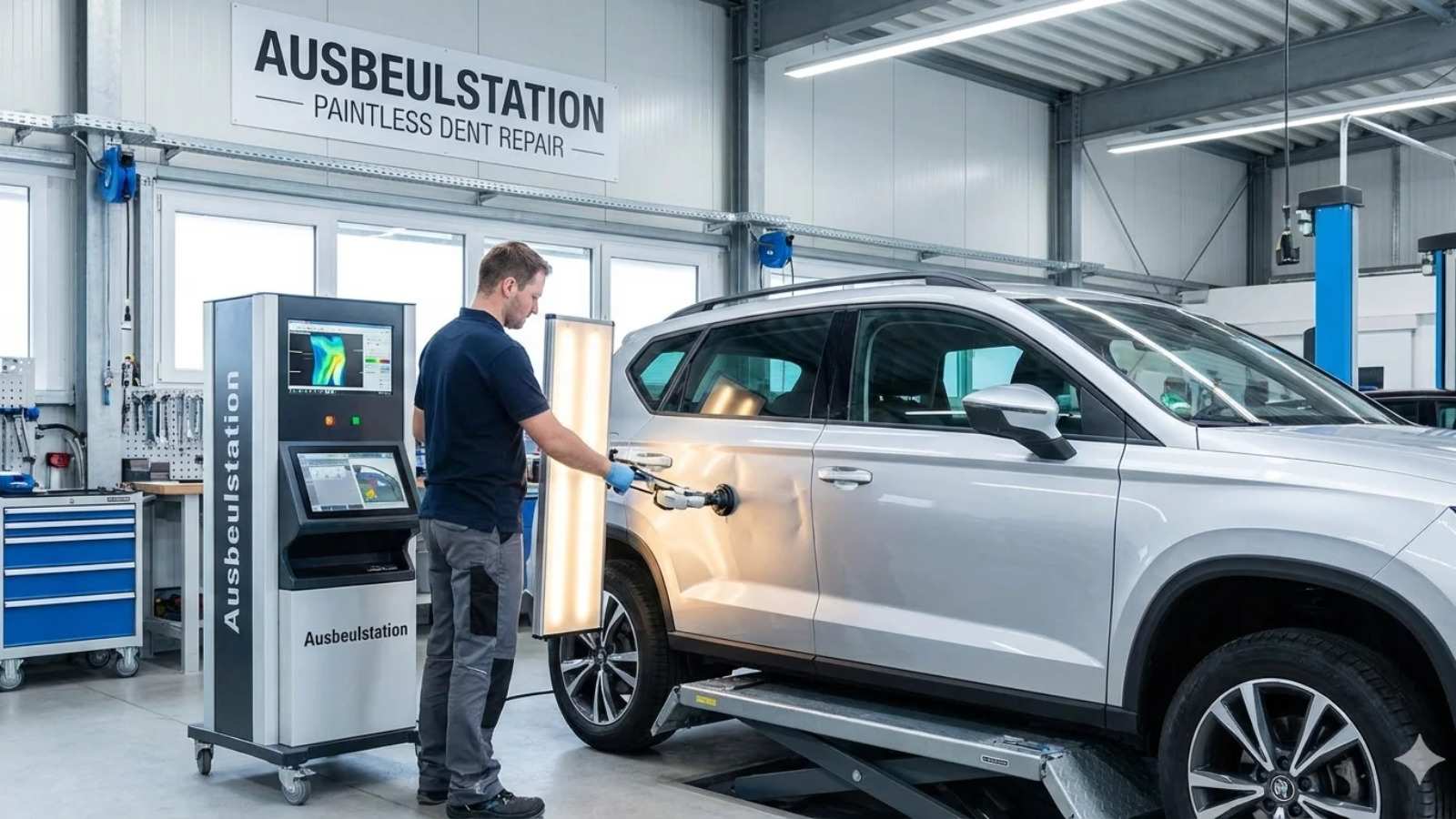
Every vehicle owner knows the frustration of discovering a dent after a storm, in a parking lot, or from a minor collision. Traditionally, fixing such damage meant costly bodywork, panels removed for repainting, and several days without your car. But today, many auto workshops rely on an advanced system called the Ausbeulstation — a specialized dent removal station designed to fix dents efficiently, preserve factory paint finishes, reduce repair costs, and improve workshop productivity. In this comprehensive guide, we explore the meaning, techniques, tools, applications, and future of the Ausbeulstation in the automotive repair world.
1. What Is an Ausbeulstation?
The word Ausbeulstation comes from German, where “ausbeulen” means to remove a dent and “station” refers to a dedicated work area or system. In essence, an Ausbeulstation is a dedicated dent repair workstation equipped with the specialized tools and lighting required for advanced panel repair — most often paintless dent repair (PDR).
At its core, an Ausbeulstation allows technicians to restore a vehicle’s body surface by reshaping the metal rather than sanding and repainting. This ensures the original factory paint remains intact, which not only maintains the vehicle’s value, but also dramatically cuts repair time and material waste compared to conventional bodywork.
2. Historical and Practical Background of Ausbeulstation
Although the term originates in German-speaking repair markets, the concept of specialized dent repair has become widespread in professional auto workshops globally. Modern automobiles use materials like steel and aluminum panels, requiring precise techniques to reshape without damaging the surface.
Historically, auto body repair involved heavy fillers, sanding, primers, and often repainting. With evolving technology and customer demand for cost-effective, environmentally friendly solutions, the Ausbeulstation and paintless repair methods became a mainstream alternative. Today, these systems are standard in well‑equipped body shops and hail repair facilities.
3. Core Components of an Ausbeulstation
An effective Ausbeulstation combines hardware, specialized tools, and environment control to achieve optimal results. Key components typically include:
3.1 Dent Removal Tools and Accessories
-
Customized pulling bridges
-
Glue tab systems for pulling dents
-
Precision rods and hooks for panel access
-
Spot welders for attaching pulling points
-
Adjustable pulling arms and slide hammers
3.2 Lighting and Inspection Systems
High‑intensity LED reflection boards and directional lighting help technicians detect even the slightest panel irregularities that normal lighting can miss.
3.3 Heat Application Devices
Some stations include induction heaters or heat guns. Controlled heat allows metal to become more malleable, especially on aluminum panels or in colder shop environments, which improves work quality.
3.4 Ergonomic and Workflow Setup
Ausbeulstations are organized for technicians, with tools logically placed, adjustable stands, and portable carts so repairs can be done efficiently without repositioning vehicles constantly.
4. How Ausbeulstation Dent Repair Works
Unlike traditional repair techniques, most dent work done at an Ausbeulstation follows paintless dent repair (PDR) principles:
4.1 Assessment
The technician evaluates:
-
Location and depth of the dent
-
Whether paint is intact
-
Whether the dent can be accessed from behind or needs pulling tools
4.2 Access
Panels may be temporarily disassembled (interior trims, lights, liners) to allow tool access behind the damaged area.
4.3 Push or Pull Techniques
-
Push (from behind): Technicians use rods to gently massage the metal back to its original shape.
-
Pull (from front): In restricted access areas, glue tabs or spot‑welded studs are used to pull the dent outward in controlled increments.
4.4 Fine Tuning
The technician checks the panel under reflection lights and continues micro‑adjustments until the surface is smooth and visually seamless.
5. Benefits of Using an Ausbeulstation
Focusing on paintless dent repair using an Ausbeulstation brings multiple advantages:
5.1 Preserves Original Finish and Value
Because paint isn’t sanded or refilled, the original finish stays, which is critical for resale value and vehicle history.
5.2 Time Savings
Many dents that would take days for conventional repair are completed in hours at a well‑equipped Ausbeulstation.
5.3 Cost Efficiency
Without the need for fillers, paint, and extensive labor, repair costs are often significantly lower, benefiting both customers and body shops.
5.4 Environmentally Friendly
No paint fumes, solvent waste, or sanding dust reduces pollution and waste — aligning with modern sustainability goals.
5.5 Higher Throughput
Workshops equipped with Ausbeulstations can handle more vehicles per day, especially during hail seasons or fleet repair peaks.
6. Materials and Compatibility: Steel vs. Aluminum
Modern vehicles increasingly use aluminum body panels for weight reduction. Aluminum requires more precise pressure control and heat, which advanced Ausbeulstation setups deliver. Quality stations are designed to work with both steel and aluminum surfaces without risk of cracking or paint damage.
7. Choosing the Right Ausbeulstation
When selecting or investing in an Ausbeulstation, workshops should consider:
-
Modularity: Can it be customized for specific dent types or vehicle materials?
-
Mobility: Portable carts increase flexibility.
-
Integrated Controls: Smart voltage and adjustable tool options help precision work.
-
Ergonomics: Technician comfort improves quality and reduces fatigue.
8. Future of Ausbeulstation and Dent Repair in 2026 and Beyond
As automotive repair evolves with digital diagnostics, lightweight materials, and electric vehicles, Ausbeulstations are also adapting:
-
Integration with digital measuring tools
-
Automated lighting and reflection inspection tech
-
EV‑safe systems that avoid interference with sensors and electronics
-
More cordless and battery‑powered setups
-
Customized training modules for technicians
Conclusion
The Ausbeulstation stands at the forefront of modern auto body repair. Far more than just a set of tools, it’s a complete repair ecosystem built around efficiency, precision, cost effectiveness, and quality. By enabling technicians to restore vehicle panels without repainting, it preserves original finishes, reduces environmental impact, and increases workshop productivity. Whether repairing hail dents, parking lot dings, or minor collision damage, an Ausbeulstation delivers results that meet the demands of both customers and professionals. As repair technologies progress, the Ausbeulstation will remain essential for quality, sustainable, and high‑performance dent remediation.
Frequently Asked Questions (FAQs)
1. What does an Ausbeulstation do?
An Ausbeulstation is a dedicated workstation used for removing dents and deformities in vehicle body panels, primarily through paintless methods that avoid sanding or repainting.
2. Can every dent be fixed at an Ausbeulstation?
Most shallow or moderate dents with intact paint can be fixed. Very deep, sharp creases or torn metal may still require traditional repair.
3. Is paintless repair quality as good as repainting?
Yes. When done at an Ausbeulstation by a trained technician, results often look as good as — or better than — repainting, while preserving the original finish and value.
4. How much does dent repair at an Ausbeulstation cost?
Costs vary by dent size and workshop, but paintless repair is generally 50–70% cheaper than conventional bodywork in many cases.
5. Why do insurance companies prefer Ausbeulstation repairs?
Insurance providers often approve paintless dent repair because it’s quicker, cheaper, and preserves vehicle value, which helps reduce claim expenses.
